


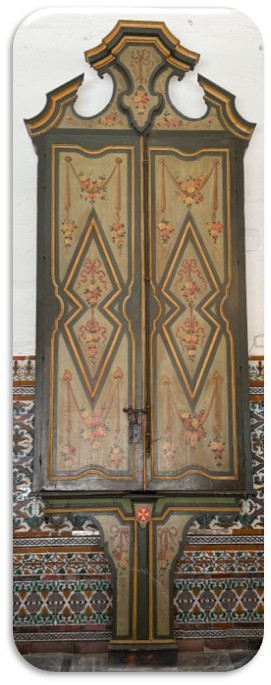
Simpecado Display Cabinet
The simpecado display cabinet preserved within the premises of the Parish Church of Saint John the Baptist (Parroquia de San Juan Bautista), commonly known as La Palma, in Seville, constitutes a paradigmatic example of Sevillian ecclesiastical furniture from the last third of the eighteenth century.
The extensive archive of the Brotherhood, insofar as it has been studied and published, contains references to a display case (vitrina) – a term commonly associated with furnishings of this kind — in which the property of the Sacramental Brotherhood was kept. Although there is no conclusive evidence that would allow these references to be identified with certainty as the present piece, its explicit mention within the church premises, together with its stylistic correspondence with the period and context in which this decorated cabinet was produced, makes such an association plausible.
The piece is several meters high consisting of a central rectangular compartment of relatively shallow depth, enclosed by a pair of doors. These doors, like the rest of the cabinet, are decorated with mouldings forming geometric ornamental patterns.
The lower section narrows into a triangular foot resting on one of its vertices, while the upper section is crowned by a tripartite broken mixtilinear pediment of late-Baroque reminiscence. This is surmounted by a large central decorative cresting element (peineta), which lends the cabinet an elegant verticality, probably extending towards the frieze of the chapel or of the original setting in which it was installed.
The entire surface is polychromed in tempera, with passages in oil-based paint, employing greenish and bluish tones characteristic of the transitional artistic language between the final phase of the Rococo and the establishment of Neoclassicism promoted by the official circles of the Court and the Madrid Academy.
Its decoration includes hyacinth-coloured draperies upon which bunches of flowers are arranged, filling the surface in a balanced and symmetrical manner. The lower section is dominated by the badge of Saint John the Baptist (Encomienda de San Juan Bautista) set against a red ground, an element most probably added at a later date.
This piece should not be confused with the so-called jaca, mentioned in the documentation as the place where the Penitential Confraternity kept its ceremonial furnishings and accoutrements at the time when the aforementioned simpecadera was made.
According to the testimony of several members of the Brotherhood, the piece was formerly located in the Baptismal Chapel, at a time when that space had ceased to fulfil its parochial function. From there, during one of the various interventions carried out in the church, it was moved to the left end wall of the Chapel of the Esquivel (Capilla de los Esquivel). It was subsequently relocated to the entrance area of the church, beneath the organ gallery, in the Gospel nave of San Juan de la Palma.