


Baby Jesus
Infant Saint John the Baptist
Mural Paintings, Stained Glass Window, and Lamp-Bearing Angels
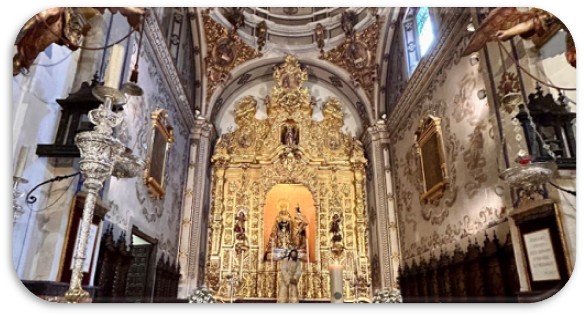
High Altarpiece
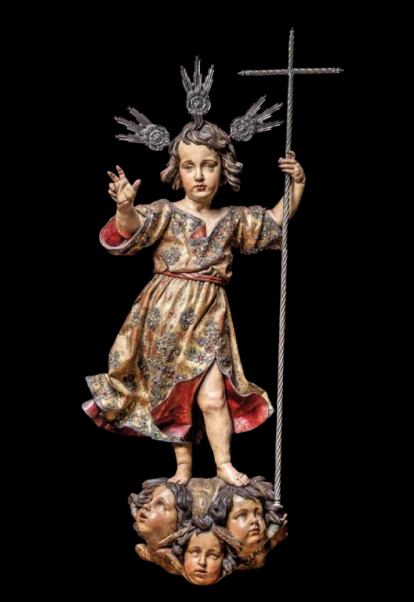
Baby Jesus
Alonso Martínez (Carving) and Gaspar de Ribas (Estofado decoration and polychromies)
1644
Polychromed wood with estofado decoration and gemstones.
Sterling silver cross.
From a compositional point of view, the image depicts Baby Jesus in the act of blessing with his right hand, while holding a delicate silver cross in his left hand, a symbol of redemption, following a composition commonly used in representations of the Risen Christ by other artists of the period.
Through the use of this iconographic formula, their intention was to emphasize the identity of the name of Jesus with the mystery of Salvation.
This idea is reinforced by the throne of cherubs upon which he stands, since these angelic beings are regarded as guardians of God.
He is dressed in a short tunic with a wide neckline, animated with dynamic folds and strong contrasts of light, more closely resembling the effects produced by paper than those produced by fabric, a characteristic feature of Castilian taste, represented in this context by the Leonese sculptor Alonso Martínez, as can also be observed in the Concepción grande del Corpus Hispalense (Large Immaculate Conception of the Corpus of Sevilla).
His, is a rose-pink robe, referring to purple colour traditionally associated with kings and emperors, since this dye, produced from the secretion of murex shellfish, was extremely expensive and therefore an irrefutable and clear symbol of social distinction. Baby Jesus, as an expression of Divine Providence, adopts this royal attire to reveal himself to the world as a new Solomon.
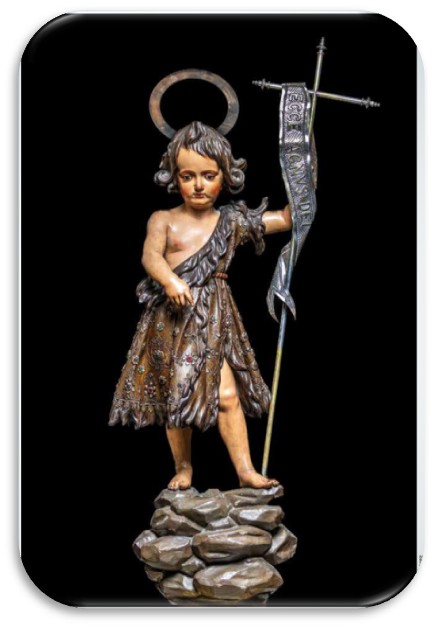
Infant Saint John the Baptist
Infant Saint John the Baptist (San Juanito)
Attributed to Francisco Dionisio de Ribas
Mid-seventeenth century
Polychromed wood with estofado decoration and gemstones.
Sterling silver cross and labarum
This sculpture forms a pair with the figure of Baby Jesus (Niño Jesús) and, although no
documentary references concerning its origin are found, it is attributed to Francisco Dionisio
de Ribas, perhaps because it originally belonged to the altarpiece this artist created for the
Divine Child (Niño Dios), with which it also shares certain stylistic affinities, particularly
regarding the estofado decoration and polychromies.
The theological basis for this childhood representation of the Forerunner is found in the liturgy
of his Nativity, whose Gradual proclaims: “Before forming you in the womb, you were known;
and before you were born, you were sanctified”
And it is complemented by the chants of Alleluia and Communion in the same solemnity,
adding: “And you, little child, shall be called the prophet of the Most High, for you shall go
preceding the Lord to prepare his ways.”
This explains the proliferation of sculptures of this type, both within the Sevillian School and in
other Hispanic and foreign artistic traditions.
The saint is elegantly dressed in a camel-skin tunic embellished with gemstones and fastened
on one shoulder, while the other remains entirely bare and uncovered.
He is shown in the act of pointing with one hand toward the Lamb — “Behold the Lamb of
God, who takes away the sins of the world” — while with the other hand he holds a labarum
bearing the message in Latin: Ecce Agnus Dei.
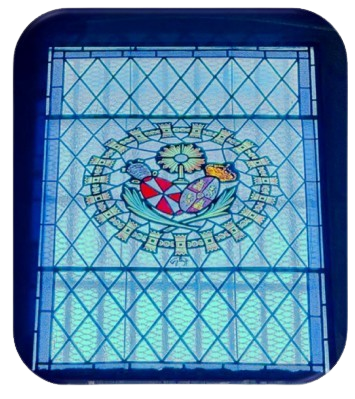
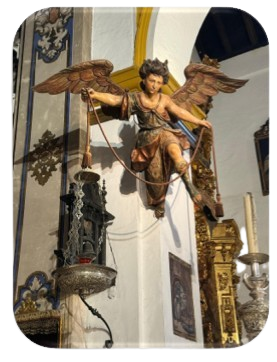
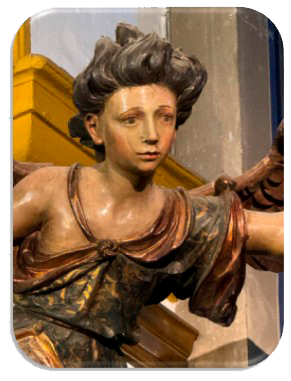
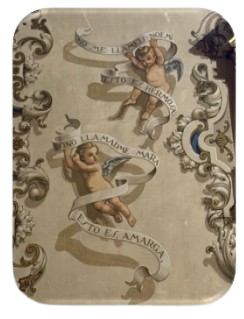
Pinturas murales, vidriera y ángeles lampareros.
Originally from the Church of Saint Philip in Carmona (Iglesia de San Felipe de Carmona), this altarpiece was executed around 1770 and signed by artist González Guisado in 1777. Designed in the late Baroque rocaille style, it was originally dedicated to Our Lady of the Incarnation (Virgen de la Encarnación).
The deed of cession was signed on June 4th 1959 by the parish priest of Saint Bartholomew of Carmona (San Bartolomé de Carmona), Fr. José Guzmán Espejo; by the Brother Superior of the Confraternity (Hermano Mayor de la Cofradía), Mr. Manuel Bermudo Barrera; and with the approval of the parish priest of Saint Peter and Saint John of La Palma (San Pedro y San Juan de la Palma), Fr. Francisco Cruces Martín. Document sealed by both parishes and brotherhoods.
The price agreed was 50.000 pesetas, although modifications were required in order to adapt the structure to its present dimensions of 11 meters height and 6 meters width. The altarpiece was restored and gilded with fine gold leaf by Francisco Ruiz Rodríguez, at a total cost of 230.000 pesetas.
In July 1959, it was installed in the presbytery and solemnly blessed on March 20th 1960 by His Eminence José María Bueno Monreal, Cardinal Archbishop of Seville. The image of Mary Most Holy of Bitterness (María Santísima de la Amargura), accompanied by Saint John the Evangelist (San Juan Evangelista), was placed within its chapel, becoming the first image of the Sorrowful Virgin (Dolorosa) to preside over the high altarpiece of a parish church.
The altarpiece is made up of an altar table bearing the coat of arms of the Brotherhood at its center, a predella or base, a main body, and an attic section. In the lower part of the lateral sections, two small double-leaf doors open onto the minor sacristy.
The predella is decorated with vertically arranged rocaille ornamentation, intended to enhance the impression of height. At its center stands the semicircular tabernacle , whose door bears a painted image of the Good Shepherd with a sheep and a cartouche inscribed with the words: “I am the Good Shepherd” (“Yo soy el Buen Pastor”). The entire composition is framed by a mixtilinear arch covered with foliate ornamentation that extends into the first tier of the altarpiece.
The altarpiece is divided into three vertical bays. At the center of the main body, in the central bay, is the camarín, or shrine chamber, where the images of the Virgin and Saint John the Evangelis are venerated. It is semicircular in form and crowned with vegetal motifs that rise from the keystone of the arch into the attic section above.
The lateral bays are framed by recessed pilaster-like supports with intermittent decoration arranged vertically, similar to that of the predella, again emphasizing the height.
At the center of each side bay stand the magnificent images of the Christ Child (Niño Jesús) and the Young Saint John the Baptist (San Juanito), outstanding examples of childhood imagery in Sevillian Baroque sculpture.
Both figures stand upon individual plinths, framed by very simple niches, semicircular in their upper section and bordered by gently undulating lines at the sides.
On both sides, within decorative panels rising to the height of the camarín, appear Marian symbols and attributes associated with the Virgin. In 1959, four additional symbols from the litany were added, to adapt the altarpiece to its new location.
From top to bottom and left to right, these symbols are: the Enclosed Garden (Jardín cerrado), Star of the Sea (Estrella del mar), Tall as the Palm Tree (Alta como la palmera), Fair Olive Tree (Oliva vistosa), House of God (Casa de Dios), Chosen as the Sun (Escogida como el sol), City of God (Ciudad de Dios), Fountains of Gardens (Fuentes de huertos), Gate of Heaven (Puerta del cielo), Rose Plant (Planta de rosas), Fair as the Moon (Hermosa como la luna), Well of Living Water (Pozo de agua viva), Spotless Mirror (Espejo sin mancha), Tower of David with bulwark (Torre de David con baluarte), Tall as the Cypress (Alta como el ciprés), and Ark of the Covenant (Arca de la Alianza).
The Tower of David (Torre de David) is represented in the form of the tower of Saint Bartholomew of Carmona (San Bartolomé de Carmona), a detail that reveals the altarpiece’s place of origin.
The outer edges of the altarpiece are framed by richly decorated pilasters, with pronounced widening at the entasis.
This entire main body is separated from the attic section by a broad cornice with curvilinear contours, rising at the center to accommodate the crowning element of the camarín with the emblem of the Queenship of Mary (Realeza de María). This cornice was made by Antonio Díaz Fernández, a member of the Brotherhood, at a cost of .,000 pesetas.
Unlike the lower section, the attic is completely covered with rocaille decoration. At its center, aligned vertically with the camarín below, there is a niche containing the titular image of the church, Saint John the Baptist (San Juan Bautista). On both sides there are two relief medallions depicting Saint Joachim (San Joaquín) and Saint Anne (Santa Ana), the parents of the Virgin Mary, while the outer ends are completed by two angels holding olive branches in their hands.
The attic is in turn surmounted by a small broken cornice, raised in its upper section and flanked by two angels with outstretched arms, leading to the final cresting of the altarpiece. This crowning element consists of a medallion depicting the scene of the Annunciation (Anunciación), surrounded by the same rocaille decoration that characterizes the rest of the work.
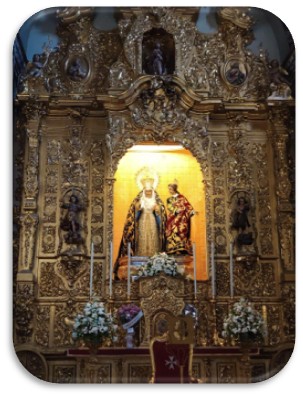
High Altarpiece (Retablo del Altar Mayor)
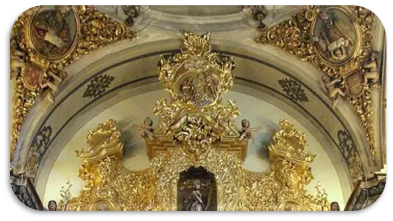
Originally from the Church of Saint Philip in Carmona (Iglesia de San Felipe de Carmona), this altarpiece was executed around 1770 and signed by artist González Guisado in 1777. Designed in the late Baroque rocaille style, it was originally dedicated to Our Lady of the Incarnation (Virgen de la Encarnación).
The deed of cession was signed on June 4th 1959 by the parish priest of Saint Bartholomew of Carmona (San Bartolomé de Carmona), Fr. José Guzmán Espejo; by the Brother Superior of the Confraternity (Hermano Mayor de la Cofradía), Mr. Manuel Bermudo Barrera; and with the approval of the parish priest of Saint Peter and Saint John of La Palma (San Pedro y San Juan de la Palma), Fr. Francisco Cruces Martín. Document sealed by both parishes and brotherhoods.
The price agreed was 50.000 pesetas, although modifications were required in order to adapt the structure to its present dimensions of 11 meters height and 6 meters width. The altarpiece was restored and gilded with fine gold leaf by Francisco Ruiz Rodríguez, at a total cost of 230.000 pesetas.
In July 1959, it was installed in the presbytery and solemnly blessed on March 20th 1960 by His Eminence José María Bueno Monreal, Cardinal Archbishop of Seville. The image of Mary Most Holy of Bitterness (María Santísima de la Amargura), accompanied by Saint John the Evangelist (San Juan Evangelista), was placed within its chapel, becoming the first image of the Sorrowful Virgin (Dolorosa) to preside over the high altarpiece of a parish church.
The altarpiece is made up of an altar table bearing the coat of arms of the Brotherhood at its center, a predella or base, a main body, and an attic section. In the lower part of the lateral sections, two small double-leaf doors open onto the minor sacristy.
The predella is decorated with vertically arranged rocaille ornamentation, intended to enhance the impression of height. At its center stands the semicircular tabernacle , whose door bears a painted image of the Good Shepherd with a sheep and a cartouche inscribed with the words: “I am the Good Shepherd” (“Yo soy el Buen Pastor”). The entire composition is framed by a mixtilinear arch covered with foliate ornamentation that extends into the first tier of the altarpiece.
The altarpiece is divided into three vertical bays. At the center of the main body, in the central bay, is the camarín, or shrine chamber, where the images of the Virgin and Saint John the Evangelis are venerated. It is semicircular in form and crowned with vegetal motifs that rise from the keystone of the arch into the attic section above.
The lateral bays are framed by recessed pilaster-like supports with intermittent decoration arranged vertically, similar to that of the predella, again emphasizing the height.
At the center of each side bay stand the magnificent images of the Christ Child (Niño Jesús) and the Young Saint John the Baptist (San Juanito), outstanding examples of childhood imagery in Sevillian Baroque sculpture.
Both figures stand upon individual plinths, framed by very simple niches, semicircular in their upper section and bordered by gently undulating lines at the sides.
On both sides, within decorative panels rising to the height of the camarín, appear Marian symbols and attributes associated with the Virgin. In 1959, four additional symbols from the litany were added, to adapt the altarpiece to its new location.
From top to bottom and left to right, these symbols are: the Enclosed Garden (Jardín cerrado), Star of the Sea (Estrella del mar), Tall as the Palm Tree (Alta como la palmera), Fair Olive Tree (Oliva vistosa), House of God (Casa de Dios), Chosen as the Sun (Escogida como el sol), City of God (Ciudad de Dios), Fountains of Gardens (Fuentes de huertos), Gate of Heaven (Puerta del cielo), Rose Plant (Planta de rosas), Fair as the Moon (Hermosa como la luna), Well of Living Water (Pozo de agua viva), Spotless Mirror (Espejo sin mancha), Tower of David with bulwark (Torre de David con baluarte), Tall as the Cypress (Alta como el ciprés), and Ark of the Covenant (Arca de la Alianza).
The Tower of David (Torre de David) is represented in the form of the tower of Saint Bartholomew of Carmona (San Bartolomé de Carmona), a detail that reveals the altarpiece’s place of origin.
The outer edges of the altarpiece are framed by richly decorated pilasters, with pronounced widening at the entasis.
This entire main body is separated from the attic section by a broad cornice with curvilinear contours, rising at the center to accommodate the crowning element of the camarín with the emblem of the Queenship of Mary (Realeza de María). This cornice was made by Antonio Díaz Fernández, a member of the Brotherhood, at a cost of .,000 pesetas.
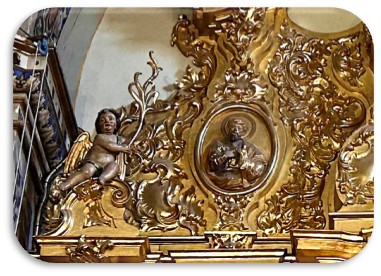
Unlike the lower section, the attic is completely covered with rocaille decoration. At its center, aligned vertically with the camarín below, there is a niche containing the titular image of the church, Saint John the Baptist (San Juan Bautista). On both sides there are two relief medallions depicting Saint Joachim (San Joaquín) and Saint Anne (Santa Ana), the parents of the Virgin Mary, while the outer ends are completed by two angels holding olive branches in their hands.
The attic is in turn surmounted by a small broken cornice, raised in its upper section and flanked by two angels with outstretched arms, leading to the final cresting of the altarpiece. This crowning element consists of a medallion depicting the scene of the Annunciation (Anunciación), surrounded by the same rocaille decoration that characterizes the rest of the work.