


Altarpiece of the Immaculate Conception
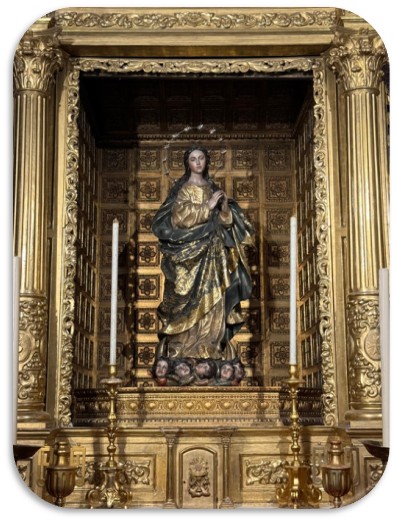
Located on one side of the Sacramental Chapel (Capilla Sacramental), opposite to one of its access grilles, this altarpiece is conceived as a chapel-like structure. Its architectural design is therefore entirely subordinated to the purpose of housing the image venerated there: the Immaculate Conception.
The altarpiece underwent remodeling in 1935, the work being carried out by the gilder Francisco Ruiz Rodríguez. All the wood used in the intervention was donated by Mr. Eusebio Pérez Romero, a member of the Brotherhood.
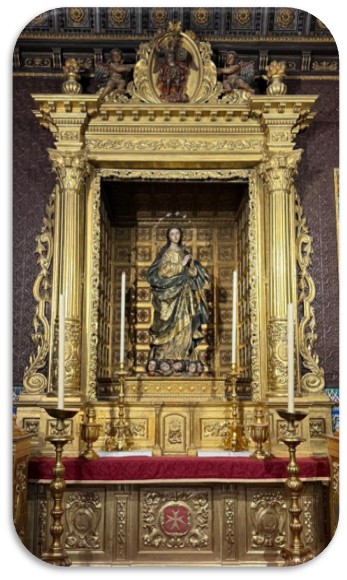
The altar frontal, made of gilded wood, bears the Maltese Cross (Cruz de Malta) at its centre.
The predella incorporates a fixed tabernacle (sagrario) flanked by two columns with capitals and a cresting element. Its gilded wooden door bears the image of a chalice.
The niche housing the image takes the form of a lintelled, box-like recess, decorated with coffered panels that harmonise with the coffered vaulting covering the second section of the Sacramental Chapel (Capilla Sacramental). It is fitted with a sliding iron door.
On certain dates of the year, this altar is used to house the images of Mary Most Holy of Bitterness (María Santísima de la Amargura) and Saint John the Evangelist (San Juan Evangelista), since this was their devotional altar from 1904 until they were transferred to the High Altar.
The altarpiece features two large columns with Corinthian capitals, fluted in their upper sections and carved in relief below, bearing a Sorrowful Heart (Corazón doloroso) and the emblem of Saint John.
The ornamentation is relatively restrained, following the same stylistic model as the Altarpiece of Our Father Jesus of Silence. It consists of foliage and fruit motifs that intertwine, lending marked movement to the composition. These decorative elements appear chiefly on the altar frontal, the predella, the frame surrounding the image, the bases of the columns, and the lateral sections of the altarpiece.
The composition is crowned by a large entablature comprising a frieze of garlands and a large medallion depicting Saint Michael the Archangel, supported by two angels seated upon undulating ornamental motifs. The archangel and the angels belonged to the earlier altarpiece that formerly occupied the same location.
Each year, the Vigil of the Immaculate Conception (Vigilia de la Inmaculada) is celebrated at this altar. On certain occasions, it has also housed the image of the Christ Child, as occurred when the image of the Immaculate Conception was transferred to the altar erected by the Brotherhood for the Corpus Christi) procession in Francos Street.
In June 1975, the image of the Lord of Silence was placed on this altar when the mortal remains of the Brotherhood’s Honorary Senior Brother, Mr. Luis Ortiz Muñoz, arrived from Madrid for his funeral before the Most Holy Virgin of Bitterness.
The image of the Most Pure Virgin (Purísima) came from the Church of Saint Michael, from where it arrived in the nineteenth century. Although Neoclassical in appearance, the work itself dated from a considerably earlier period, perhaps the late seventeenth century, suggesting that it had been reused from an earlier ensemble.
The proximity of Francisco Buiza’s workshop to the canonical seat, together with his close friendship with the sacristan—who was always deeply committed to the Brotherhood’s activities—led to Buiza being commissioned to transform the relief into a sculpture in the round. He completed the task to general satisfaction within a short period of time, and on the afternoon of 19 March 1960 the image was solemnly transferred from the convent of the Sisters of the Cross (Hermanas de la Cruz), where it had been blessed.
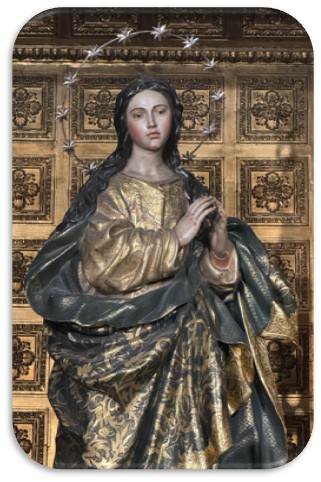
Life-size, the sculpture depicts the Virgin in an attitude of prayer, in keeping with forms that were common within the Sevillian school during the second half of the seventeenth century. At that time, the spindle-shaped composition explored in previous decades by the great Alonso Cano still exerted considerable influence.
She wears a hyacinth-coloured tunic, visible up to the neck, one of the colours prescribed in Exodus for priestly vestments. This emphasises the idea of Mary’s consecration to the Father from the very first instant of her being.
Her dark blue mantle—evoking the garments of salvation and the mantle of justice mentioned in the Introit for December the 8th —falls from the left shoulder towards the right hip, crossing towards the opposite arm as a sign of virginity, in accordance with the formula commonly found in most Marian images of Glory.
This latter symbolism is further reinforced by her loose flowing hair, a characteristic feature of the iconography of the Immaculate Conception. Her head is encircled by the twelve stars of the Book of Revelation (Apocalipsis). The Gradual and the Alleluia of this solemnity are connected with this symbolism and, drawing upon the Book of Judith , also express Mary’s motherhood over the Church, constituted at Pentecost.
For its part, the rich estofado work of the mantle alludes to Psalm 104: “Wrapped in light as with a garment”, while the moon placed beneath her feet refers once again to the aforementioned verse from the Book of Revelation.
At Mary’s feet there also appears the serpent, presenting her as the new Eve: just as Original Sin entered the world through the first woman, so, through Mary, grace and redemption are announced.