


Royal Sevillian Confraternity of Our Lady of La Cabeza
The Brotherhood of Our Lady of La Cabeza (Hermandad de la Virgen de la Cabeza) was founded on 8 February 1931 in the Parish Church of Saint Vincent Martyr (Parroquia de San Vicente Mártir) in Seville, with the purpose of fostering devotion to the Patroness of Andújar (Patrona de Andújar) among the sizeable community of people from Jaén who had settled in the city during the 1920s.
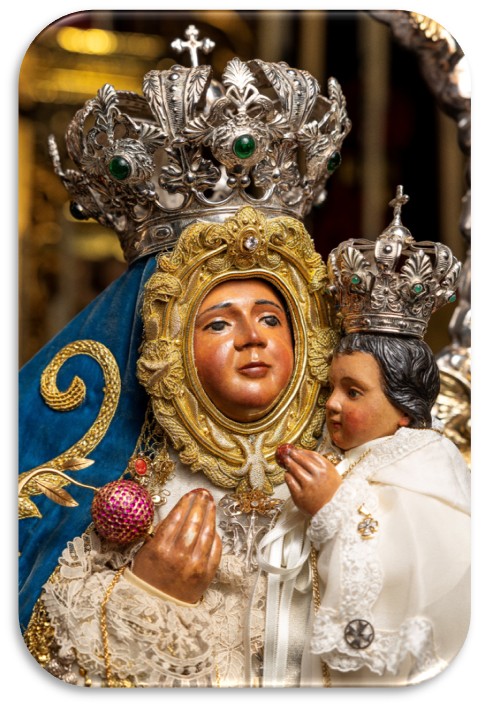
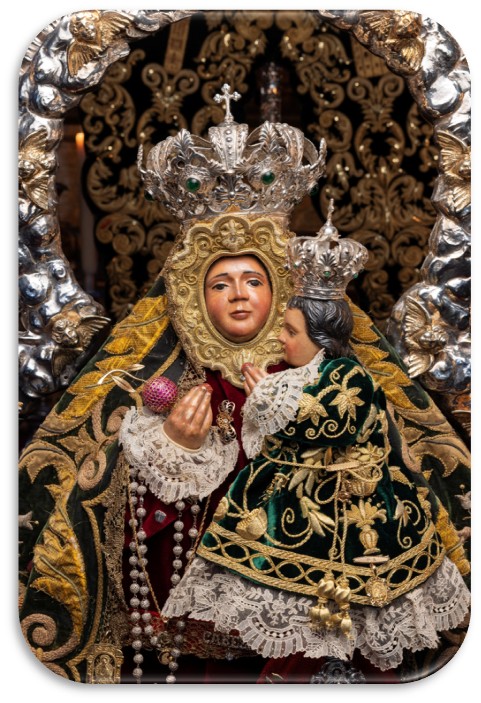
The image of the Virgin, dating from 1931, is the work of the Andújar-born sculptor Fernando Cruz Muñoz, father of the renowned restorers Cruz Solís, together with the Alcalá-born artist Manuel Cerquera Becerra. Carved as a full-length figure, it reproduces the original image of Our Lady of La Cabeza of Sierra Morena (Virgen de la Cabeza de Sierra Morena), which disappeared during the tragic events of 1937. The sculpture was restored by Francisco Buiza in 1970 and by Rocío Sáenz Millán in 2009.
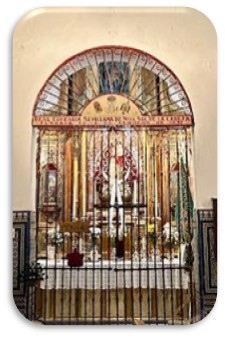
The Brotherhood, whose first rules date from 1932, initially had its canonical seat in the Conventual Church of Saint Bonaventure (Iglesia Conventual de San Buenaventura), where it remained until 1940. In that year, by decree of the Archbishop of Seville His Most Reverend Excellency Pedro Segura y Sáenz, it was transferred to the church of San Juan de la Palma, occupying the chapel that, until 1936, had been presided over by the image of Our Lady of Wonders (Virgen de las Maravillas) by Benito Hita del Castillo.
The Brotherhood occupies a chapel in the nave of the Epistle presided over by an altarpiece in a restrained Neoclassical style. Within the altarpiece are two paintings depicting, respectively, the apparition of the Blessed Virgin (Santísima Virgen) to the shepherd Juan Alonso de Ribas in 1227, and the Sanctuary in Sierra Morena where she is venerated. Both works were executed in 1951 by the Sevillian painter Mr. Francisco Fernández Romero.
At San Juan de la Palma, the Brotherhood reached the height of its popularity. During the 1940s, 1950s and 1960s, it led the procession held on the feast of Saints Peter and Paul, accompanied by a large detachment of the Civil Guard (Guardia Civil).
At the beginning of the 1970s, in response to the political and social changes then taking place in Spain, the Brotherhood suspended the procession for several years, concentrating its efforts on the Brotherhood House that it owns in Sierra Morena, to which its members travel each year for the Pilgrimage (Romería) held on the last Sunday of April.
In 1981, this annual act of external worship was restored, thereafter being fixed on the first Saturday of October. In 2016, Our Lady of La Cabeza (Virgen de la Cabeza) presided over the Proclamation of the Brotherhoods of Glory of Seville (Pregón de las Hermandades de Gloria de Sevilla) in the Holy Cathedral Church , and was accompanied on her return procession by numerous brotherhoods and confraternities dedicated to the Blessed Virgin of La Cabeza from throughout Andalusia.