


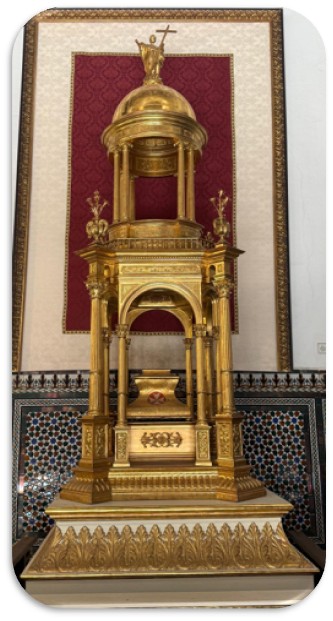
Processional Monstrance
According to research performed by José Damián Huerta Hidalgo, the former archivist of the Brotherhood, the confraternity acquired a wooden monstrance in 1948. This piece, painted in white and gold, was crafted by carpenter Francisco Ruiz. It was part of renewing the Sacramental Brotherhood’s assets after the destruction and looting in 1936. The wood for the monstrance was donated by our member of the Brotherhood Eusebio Pérez Romero, and it became part of the Holy Thursday Monument.
The entire Monument, which included the monstrance, replaced an earlier structure in the Sacramental Chapel. However, the various elements are usually used separately rather than together. If assembled, the complete arrangement would create a large stepped pyramid that would fill the width of the nave of San Juan de la Palma, as shown in period photographs.
Published documents suggest that this piece was not meant for processions at first. Although seen as a modern creation when acquired, it connects directly to other Neoclassical wooden monstrances in Seville, such as the one at the Parish Church of San Isidoro.
The structure has two tiers. The lower tier has a square shape with chamfered corners. It is supported by a double order of giant columns at each corner. It also includes four semicircular arches supported by smaller columns, which are connected on each side by raised semicircular arches.
The upper tier has a circular shape and is topped by a small temple-like structure above a domelet. This domelet features the allegorical figure of the Faith. This design follows the traditional style of Spanish processional monstrances, inspired by the famous monstrance created by Juan de Arfe in Seville Cathedral.
The monstrance has finely carved Corinthian style capitals on the lower tier and Ionic style capitals on the upper tier. It closely follows the traditional entablature proportions of Classical architecture as detailed by Vitruvius. Four small ornamental urns decorate the corners of the balustrade connecting the two tiers.
The structure is also adorned with small Neo-Baroque decorative plaques that fill available spaces like plinths and friezes, along with carved stucco ornamentation.
As of today, the monstrance is gilded in fine gold and is in good condition. The entire structure sits on a square pedestal decorated with a stylised repeating pattern of palmettes or acanthus leaves. This distinctly Oriental motif seems somewhat out of place with the architectural style of the tower monstrance itself. The pedestal is the only part that retains the original white-and-gold polychrome that the entire ensemble was designed with. The lower tier is open for various liturgical uses during Holy Thursday. It may hold the reservation urn (a modest piece originally crowned by three crosses arranged as a Calvary) or the ostensorium-monstance or the tabernacle, depending on the liturgical occasion. Our Brotherhood uses either the complete structure or just the lower tier, depending on the situation. When in procession, the upper tier currently features a kneeling seraph, which likely once belonged to a pair that appeared during the adoration at the Eucharist. Professor María Jesús Sanz has proposed that the upper section likely originally held an Apocalyptic Mystical Lamb that is now lost. Our Brotherhood has often used this monstrance for ceremonial purposes during extraordinary processions of the Blessed Sacrament through the parish district, in various internal devotional altars, and as part of the decorative setups for the city’s general Corpus Christi procession.