
'/%3E%3Cpath%20fill='%23b2b2b2'%20d='M241%20382q0%2016%2017%2026%2017%2011%2042%2011t42-11q16-11%2017-26V269H241'/%3E%3Cpath%20fill='%239f7e00'%20d='M241%20379q0%2014%208%2023%209%209%2021%209%2014%200%2021-9%209-9%209-23V269h-59'/%3E%3Cpath%20d='M241%20339v-70h59v110q0%2014-9%2023l-6%205v-68h-15v72q-8%200-14-4v-68zm59%2040c0%2022%2015%2032%2029%2032%2021%200%2030-18%2030-32v-40h-59'/%3E%3Cpath%20fill='%239f7e00'%20d='M266%20277v5h2v12h-3v-5h2v-5h-9v5h2v5h-4v9h3v18h-5v10h34v-10h-5v-18h3v-9h-4v-5h2v-5h-9v5h2v5h-3v-12h2v-5zm42%20101q0%2010%206%2017%206%206%2015%207%2010-1%2016-7%206-7%206-17v-29h-43'/%3E%3Ccircle%20fill='%230044ad'%20cx='329.5'%20cy='372'%20r='6'/%3E%3Cellipse%20fill='%230044ad'%20cx='300'%20cy='340'%20rx='16'%20ry='21'/%3E%3C/svg%3E)
'/%3E%3C/svg%3E)
Church of San Juan de la Palma
Origin of the Name:
This anecdote was told in the 17th century and recorded by Ortiz de Zúñiga. A preacher from the parish warned the heretics to be careful, because even the walls and stones could hear their blasphemies.
One of them, wishing to contradict him, stood beside the palm tree in the square and declared that the Virgin had not remained a virgin after giving birth. The following day, an old man who had heard it reported him.
The heretic denied everything, and the court asked to see the old man who had made the accusation.
However, townspeople told the court that the man had been dead for many years and was buried beneath the palm trees in the square.
Brief Overview:
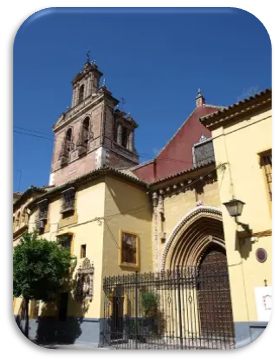
King Ferdinand ordered the construction of the church on the site of a former 11th-century mosque. In the 14th century, the church was transformed into a gothic-mudejar building. The oldest surviving elements are the tower’s internal structure, built in the mudejar style; the vault of the sacramental chapel, also mudejar; and the portal at the west end of the church.
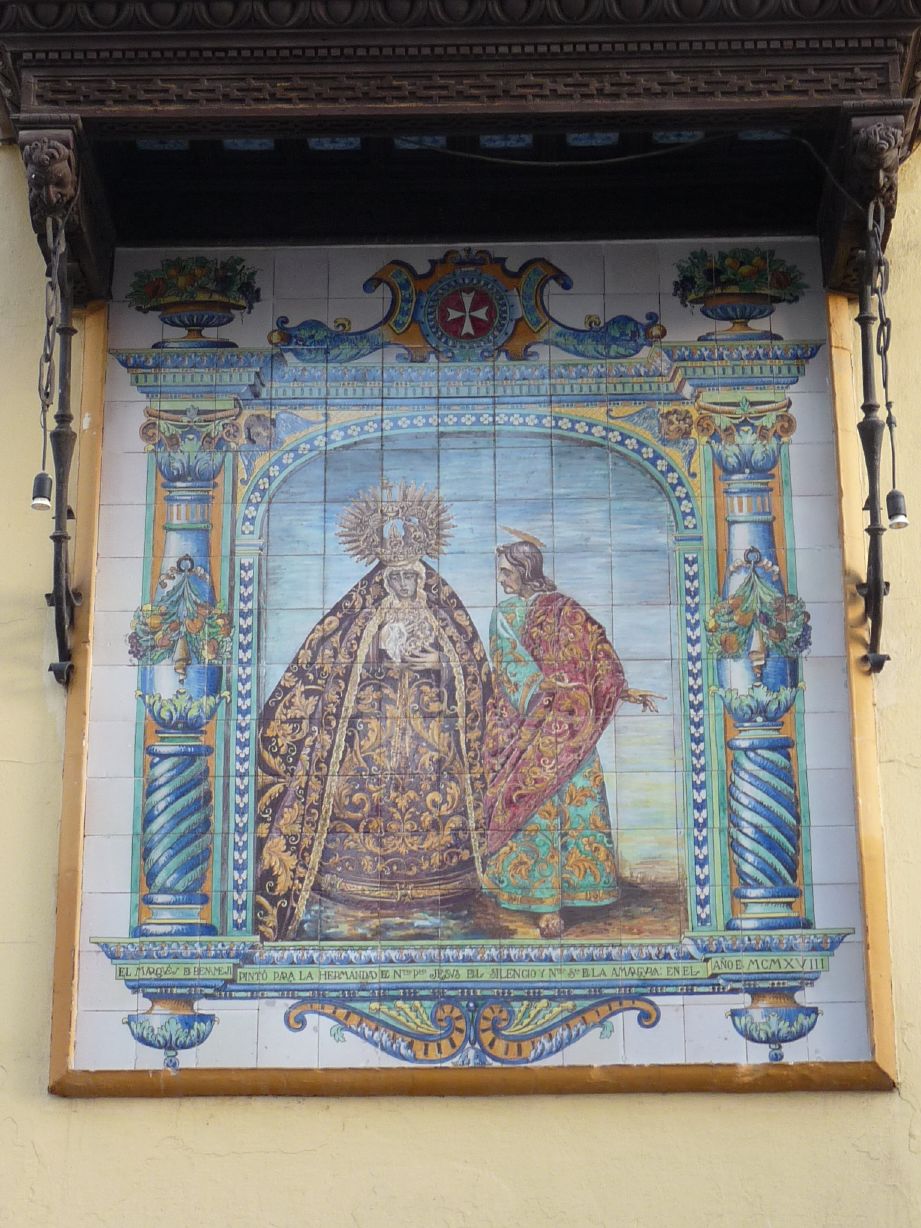
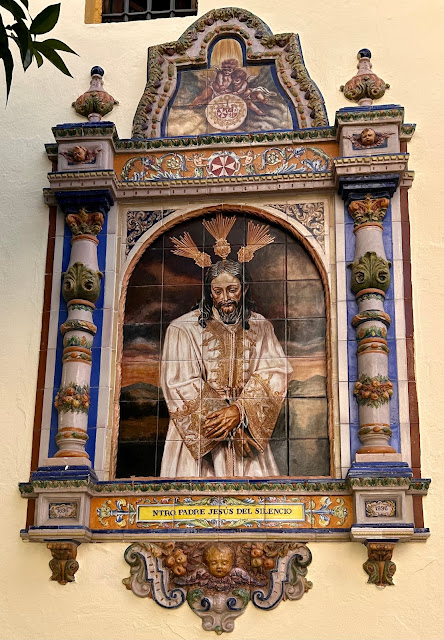
The exterior of the church is notable for its sobriety. At the western end stands a pointed-arch portal supported by clustered columns rising to the impost line, which is decorated with vegetal ornamentation. The portal is crowned by a tiled canopy. On the façade facing Feria Street, on the left-hand side, a window reveals the Cristo de los Afligidos (“Christ of the Afflicted”), a devotion originating from the now-vanished Convent of Regina Angelorum. Next to it is a ceramic altarpiece depicting the Señor del Silencio (“Lord of Silence”), created by A. Carlos Orce in 1987. On the side facing Regina Street stands a ceramic altarpiece of María Santísima de la Amargura and San Juan Evangelista (“Saint John the Evangelist”), created by Manuel de la Lastra, Marquis of Benamejí, in 1918.
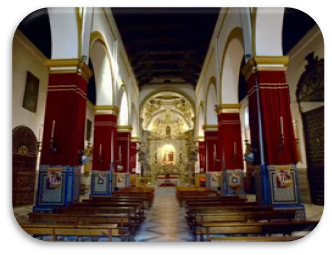
The church consists of three naves, with a presbytery, a choir at the foot of the church, and side chapels.
The church consists of one nave and two aisles, with a presbytery, a choir at the west end, and side chapels. The main altarpiece, originally from the Church of San Felipe in Carmona and made by Francisco González Guisado in 1777, was later modified, restored, and gilded with fine gold by Francisco Ruiz Rodríguez in 1960. The frescoes in the presbytery were painted by Rafael Rodríguez Hernández. The altarpiece houses the images of María Santísima de la Amargura, an anonymous 18th-century work, and Saint John the Evangelist, by Hita del Castillo, 1760. Also present on the altar are the images of the Child Jesus, by Francisco de Rivas, 1664, and Saint John as a child, by an anonymous artist.
In the Baroque altarpiece in the Epistle nave, next to the presbytery, stands the clothed image of Santa Ángela de la Cruz (“Saint Angela of the Cross”), with one of her relics placed at her feet. Apart from the remaining anonymous altarpieces and paintings from the 17th and 18th centuries, special mention should be made of the sacramental chapel, where the image of Nuestro Padre Jesús del Silencio (“Our Father Jesus of Silence”), attributed to the workshop of Pedro Roldán, circa 1698, is venerated.
Also worthy of mention is the Esquivel Chapel, located at the base of the tower. It was acquired in 1511 by the Esquivel family as a funerary chapel and, in 1724, became the headquarters of the Brotherhood of La Amargura after its transfer from the Church of San Julián. From then until 1904, when it merged with the Sacramental Brotherhood of San Juan de la Palma, the brotherhood’s principal devotions were worshipped there. In recent times, remains of what has been identified as the scene of The Mystical Marriage of Saint Catherine of Alexandria were discovered on its main wall.