


The Fall of Manna
This painting was executed for the Sacramental Chapel of the then Parish Church of San Juan de la Palma. Originally, this space was divided into two bays, forming what was effectively a double chapel. The bay used for sacramental worship was the one closest to the presbytery and stood under the patronage of the Marquises of Fuentes and the Counts of Talahara. The bay farther from the presbytery was held by the Ponce de León family, who in 1766 signed a deed ceding that space to the Sacramental Brotherhood.
This confraternal body subsequently unified the two original spaces into a single nave-like chapel, thereby giving rise to the present Sacramental Chapel. Its architectural origins may date back to the final years of the14th century and the opening years of the following century, although since then it has undergone considerable transformation in the arrangement of its elements and in its decorative programme.
It was most probably during the important refurbishment of the chapel undertaken by Manuel Gómez between years 1933 and 1935 that the painting was placed in its present location, at the same time as a pair of electrically illuminated candles was installed in front of it. According to the earlier attribution to Lucas Valdés, the Sacramental Brotherhood would have commissioned a canvas on a specific subject — the fall and gathering of manna by the people of Israel, conceived as a prefiguration of the Eucharist and therefore as a theme particularly appropriate for this type of sacramental worship space.
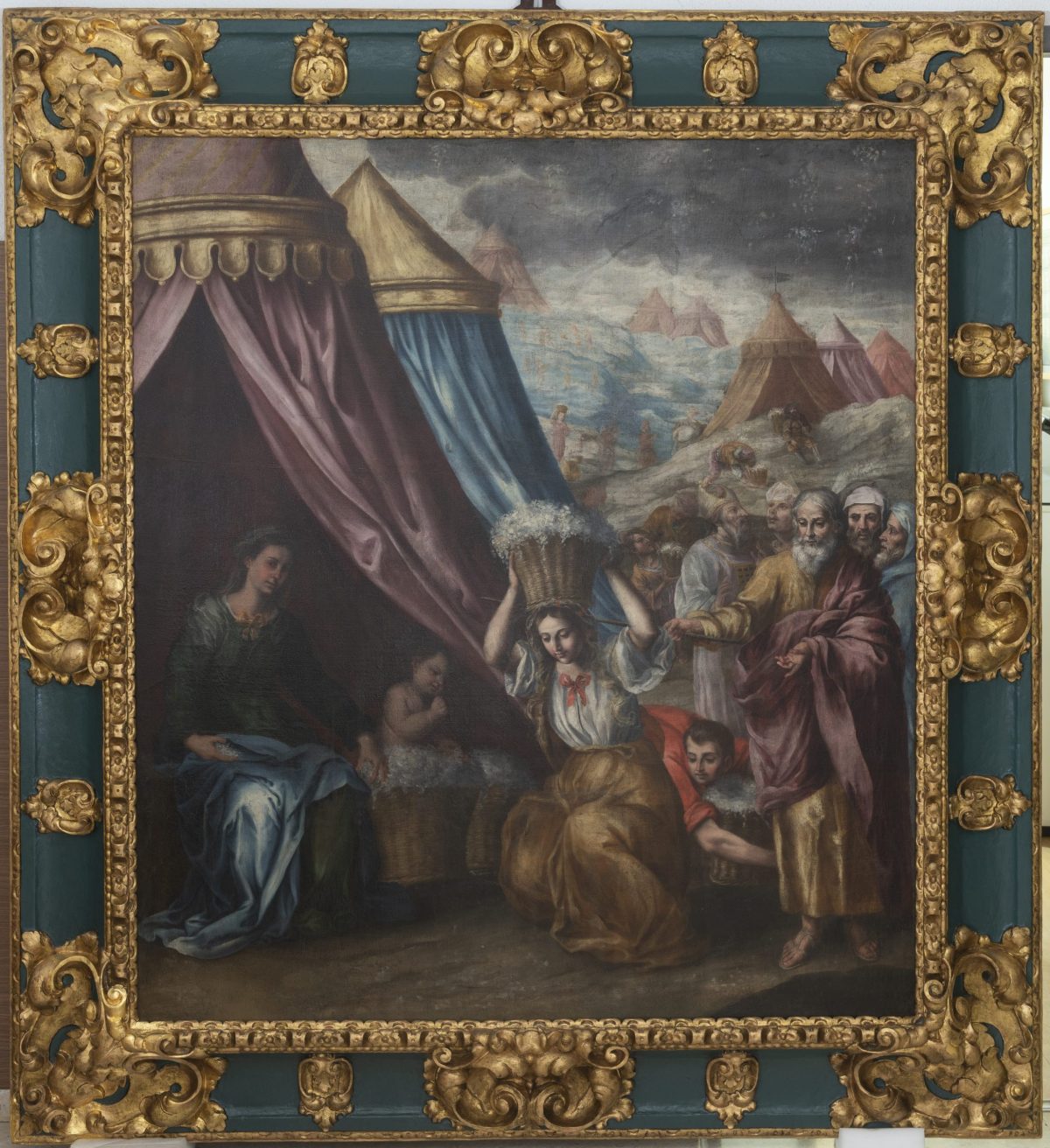
The composition represents the biblical episode from the Old Testament, recorded in the Book of Exodus 16:4–35, in which the Lord sends quail and bread from heaven to the people of Israel while they are in the wilderness of Sinai , after their departure from Egypt and at a time when they were without food. The canvas shows Moses and Aaron together with various Israelites settled in an encampment — perhaps the most compelling element of the composition — as they hasten to gather the food sent to them by the Lord, thereby manifesting His infinite mercy.
In the foreground appears a woman carrying a basket of food on her head, while in the background several figures may be seen bending down towards the ground to collect the manna. On the left-hand side of the painting are two juxtaposed tents, with figures inside anxiously awaiting the moment when their hunger will be satisfied. On the right-hand side, various other figures appear, while additional tents, represented on a smaller scale, can be discerned in the distance.
In stylistic terms, particular attention should be drawn to the sense of depth with which the subject is treated, as well as to the juxtaposition of the figures, which lends the canvas a sense of grandeur and monumentality. To this should be added the naturalness of the scene and the dynamism of the composition, features characteristic of eighteenth-century Baroque painting and close to the technical procedures and traditional models associated with the mature work of Lucas Valdés.
Ana Aranda and Fernando Quiles, however, attributed The Fall of Manna belonging to the Sacramental Brotherhood of San Juan de la Palma in Seville to Juan Ruiz Soriano, despite its earlier attribution to Lucas Valdés and notwithstanding the stylistic differences between the two painters. The human types correspond clearly to Soriano’s repertory, as the scholars perceptively observed, especially after the restoration of the work; moreover, the painting is most probably later in date.
This representation alludes to the nourishment sent from heaven to the Jewish people) to appease their hunger and is customarily understood as a prefiguration of the Eucharist . The episode is recounted in chapter 16 of the Book of Exodus. According to Fernández López, it is a work of somewhat confused compositional logic, in which the artist almost certainly made use of engraved sources to present an attractive scene centred on the image of the encampment of the Jewish people in the desert.
This painting has always remained in the same church. It was, however, very probably located from the time of its execution in the first bay of the Sacramental Chapel until the refurbishment carried out between years 1933 and 1935, when it was moved to the left wall of the western bay of the chapel.